


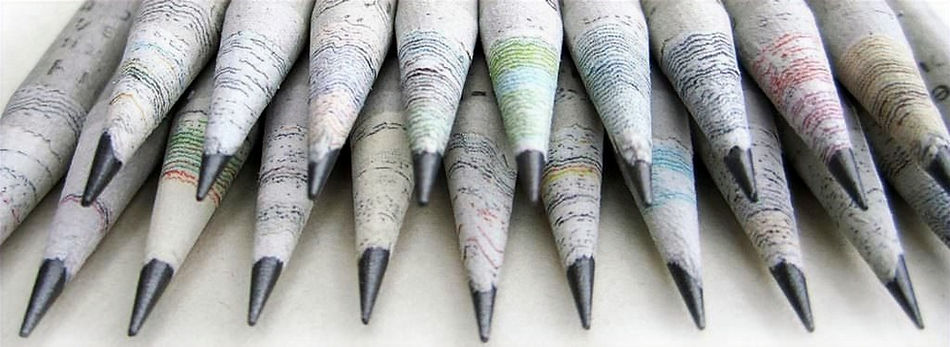
Why Recycled Paper Pencils?
Over 13 million hectares of forest is lost to deforestation, of which, 36 per cent is for paper manufacturing and 42 per cent for manufacturing timber-based products that constitutes 7 billion pencils per year in India alone, The production of wooden pencils takes a toll on our forests and environment. In India, more than one lakh trees are getting cut each year, simply to make pencils. Not just trees, there is a lot of paper we waste, that ends up going into our dying landfills. This eco-friendly hand rolled recycled paper pencil, combats both the problems with one simple solution.
"भारत में प्रतिवर्ष 700,00,00,000 (700 करोड़) पेंसिल बनाने के लिए 1,00,000 (1 लाख) से अधिक हरे व जवान पेड़ काटे जाते हैं, तथा केवल 20% बेकार कागज का पुनश्चकर्रीकरण किया जाता है और शेष 80% लैंडफिल के लिए जाता है । यानी इस्तेमाल हुए 100 किलो कागज में से केवल 20 किलो ही रिसाइकल हो पाता है और 80 किलो काग़ज़ बर्बाद हो जाता है, जो लैंडफिल में आग लगने और धुएँ से होने वाले प्रदूषण का मुख्य कारण बनता है"
“In India, more than 100,000 (1 lakh) healthy and young trees are cut every year to make 700 crore pencils. And only 20% of waste paper is recycled — the remaining 80% goes to landfills. This means that out of every 100 kg of used paper, only 20 kg gets recycled and 80 kg is wasted. This leftover waste becomes a major cause of landfill fires and pollution from smoke.”
-
Recycled Paper
There are many grey areas in waste collecting in our country. There is a lack of collection mechanism in the offices and the households. Newspaper is used for wrapping and packing. Municipalities do not play an active role in solid waste collection. There are very few paper recycling firms who have warehouse for sorting and baling.
In most of the developed countries, waste collection itself is in the organised sector. They have a wide range of legislation for packaging waste. India needs to implement a system for collection, sorting, grading and utilisation of waste paper to stop imports and reduce raw material costs.
-
So how does it work?
The first step is collecting recycled newspapers at source. The newspapers are then cut to size and the newspaper is soaked in a special glue. Next, the paper is rolled around the graphite by machines. The pencils are then dried and smoothened for kids.
-
How recycling helps in conservation?
One sheet of newspaper (of 32 cm x 56 cm size) can make around 3 pencils. Since N.E.E.V is currently distributing more than 1 lakh newspaper pencils a year, our resource conservation efforts are saving a lot of trees!
Example:-
-
Average 01 tree of average 45 feet size produces 40 kg wood pulp
-
1 Kg pulp = 200 sheets of news paper
-
40 kg pulp x 200 sheets = 8000 newspaper sheets / tree
-
1 newspaper sheet produces 3 pencil
-
20 sheets X 3 = 60 pencils (For 1 Student / Year)
Means on recycling of 8000 news paper sheets, 2700 pencils can be made for 45 students for 1 year and 01 tree is saved from cutting.
"Means by 01 student, 01 feet tree is saved, in 01 year from cutting and it also means that your 01Rs. contribution, for 01 student, can save 01 feet tree from cutting"
The market for writing instruments in India is estimated at 1600 to 2400 million pieces a year. The total market for writing instruments is estimated at Rs. 22 billion in value and is growing at around 8 to 10% annually. There is a growing demand for recycled newspaper hand rolled pencils in the market. The products find application in schools, colleges, government offices, commercial establishments, Corporates, NGOs, and miscellaneous activities.
These pencils are made from newspapers / waste papers and 100 percent recycled. So by developing / distributing recycled waste paper pencils, we are contributing a bit from our side towards the conservation of the environment and creating employment. These pencils helps in consuming old useless papers and thus plays an important role in conserving trees, air and water bodies from pollution.